Iwafune
5 Centimeters per SecondIwafune is a small town in Tochigi Prefecture, reached in the story through Iwafune Station and remembered at different points as both a place of painful separation and a home that has become dear. For Takaki Tohno, it is the destination of a winter journey to meet Akari Shinohara; for Akari, it is first the town she resents being made to live in, then the quiet hometown she cannot bear to leave. The change in its meaning is carried by concrete places: a nearly empty station, a kerosene-heated waiting room, a snow-covered walk, and a lone cherry tree beside the rice paddies.
Setting and Character
Iwafune is presented as a quiet, sparsely settled town. Its station platform opens directly onto snowfields, without a wall or fence to separate the tracks from the surrounding landscape. The town lights are distant and few; at night, the silence is interrupted mainly by the idling train. From a small pedestrian bridge, Takaki sees only a handful of illuminated houses, with the town seeming enclosed by snow. These details make Iwafune feel far removed from the busy rail corridors through which he has travelled.
The station’s wooden main building and waiting room give the place a more intimate scale. After the cold journey, warm air and the nostalgic smell of a kerosene stove meet Takaki at the entrance. Akari is sitting alone in front of it, her head drooped, when he arrives. The station is therefore not simply a point on a route: it is the sheltered room in which their long-anticipated reunion becomes immediate and personal.
Takaki’s Snowbound Arrival
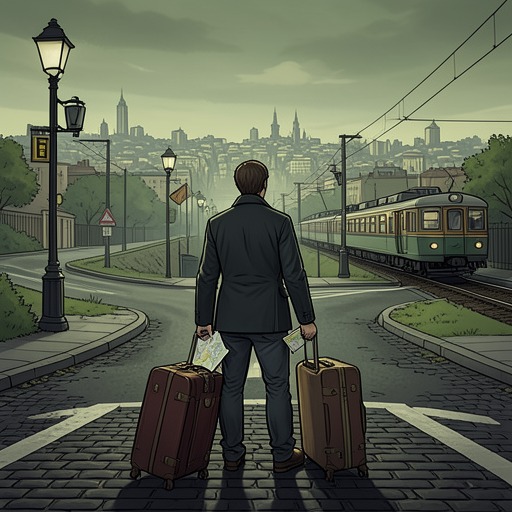
Takaki’s journey to Iwafune is planned around a precise chain of transfers. He expects to leave Gotokuji Station at 3:54, travel through Shinjuku, Omiya, and Oyama, and reach Iwafune Station at 6:45, an hour before he and Akari have agreed to meet. He has never made such a long train trip alone. His written transfer schedule, checked repeatedly, gives the meeting the appearance of something he can make happen through careful preparation.
Snow steadily dismantles that confidence. At Omiya, Takaki learns that the Utsunomiya Line is already about eight minutes behind schedule; the train continues to lose time as it pauses at stations, and he has no way to contact Akari because he has neither a mobile phone nor her home telephone number. On the Ryomo Line, service eventually stops altogether in the middle of the snow. The train has no estimated time for resuming, and Takaki is already two hours past their appointed meeting time. By the time it finally moves again, more than two hours have passed; he reaches Iwafune after eleven at night, over four hours late.
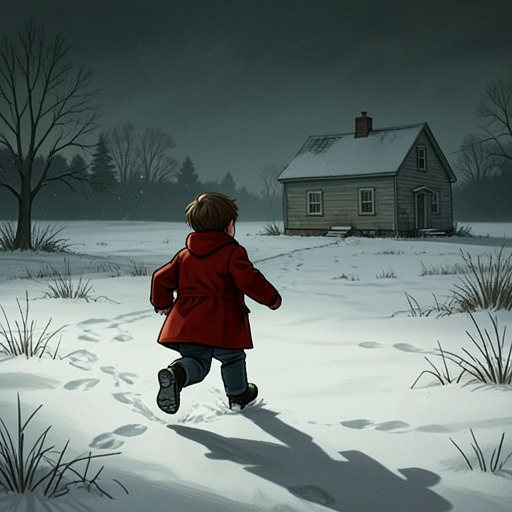
The arrival does not erase the delay. Takaki steps into deep fresh snow on a platform without barriers, then crosses the pedestrian bridge and enters the wooden station building. Akari has waited alone in the warm waiting room. Their meeting is framed by the contrast between the journey’s exposed, uncertain movement and the small interior that receives them at last. Once they leave, the town’s snow-covered streets seem strangely warm to them. Akari runs ahead beneath the pale streetlamps, and Takaki notices that she looks more grown-up than the girl he remembers.
The Cherry Tree and the Town at Night
Akari takes Takaki to the cherry tree she had written about in an earlier letter. The walk from the station takes about ten minutes, but the route leaves the houses behind and enters farmland. With no artificial light nearby, the landscape is visible mainly through the faint light reflected by snow. The tree stands alone beside a footpath between rice paddies, its trunk thick and height imposing. Beneath its interlaced branches, the two look up as snow falls silently through the darkness.
The tree gives the meeting a setting beyond the station and its timetable. It joins the town’s winter landscape to Akari’s earlier letter and to the pair’s shared childhood memories. Snow covers the ground and filters through the branches, while the absent artificial lights leave the scene apart from ordinary town life. In Iwafune, a place reached only after a journey has gone badly wrong becomes the site of a moment of closeness; the town’s quiet landscape holds both the delay and the reunion without making either disappear.
Akari’s Changing Sense of Home
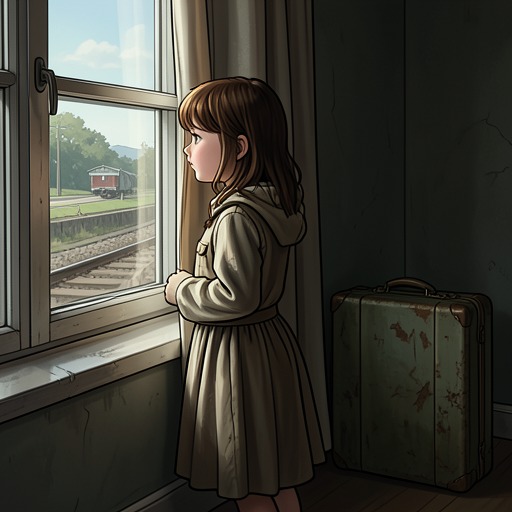
Iwafune had not always felt like home to Akari. She was born in Utsunomiya, spent her early childhood in Shizuoka, and lived in Tokyo from fourth through sixth grade. When she moved to Iwafune with her mother, her father had gone ahead and was waiting for them at the station. Although she had visited the town before because her paternal grandparents lived there, she had known it as a quiet place with little to offer, not as somewhere she wanted to live. The small platform seemed desolate, and she was so homesick for Tokyo that she nearly cried.
Her later memories revise that first impression. By the time she stands at Iwafune Station with both parents, she understands the town as her hometown and feels reluctant to leave it. Her parents’ repeated concern for her and the familiarity of the place make the impending departure especially difficult: she is preparing to marry and expects to see them again at the ceremony the following month, but their care and the small town have become precious to her. The station, once the setting for an unwanted move, is now where she waits with her parents before going away.
On another December visit, fine powdery snow falls at the station beneath clouds thin enough for patches of blue sky to show through. The snow is unlikely to build into the heavy fall associated with Takaki’s journey, yet its presence brings that earlier winter back into the landscape. Iwafune thus holds different kinds of departure: Akari’s childhood arrival, her later leave-taking from the town she has come to love, and the remembered night when she and Takaki met beneath the cherry tree.
Iwafune in the Story’s Geography of Belonging
Iwafune’s significance becomes clearer against Takaki’s own unsettled relation to place. As a child, he moved from Nagano to Tokyo and remembered the built-up landscape between Omiya and Shinjuku as an anxious contrast to the countryside he knew. Later, after high school on Tanegashima, he returned to Tokyo for university and found the city practically unfamiliar beyond the Setagaya area he had known earlier. His move was his own choice, but Tokyo still did not immediately feel like a settled home. These shifts make Iwafune more than a faraway destination: it is a place whose emotional meaning changes with experience, rather than one whose character is fixed by its geography.
The narrative also connects place to the accumulation of feeling. Takaki later thinks that sadness gathers wherever people live, and sees his apartment as having filled with it gradually, like fine dust. That reflection gives Iwafune’s earlier and later scenes an illuminating contrast. The town is not free of loneliness: Akari first experiences it as the place where she should not have to live, and Takaki reaches it through a journey marked by isolation and helpless waiting. But as Akari’s attachment develops, the same quiet surroundings become the substance of home. Iwafune’s changing meaning rests not on escape from sadness but on the relationships and memories that gather there.